We're publishing this on June 30 deliberately. Hurricane season opened June 1, its loud months are August and September, and a standby generator ordered after the first big outage joins a waiting list measured in weeks — pad, gas work, electrical, inspection. The people with power during the next multi-day outage in Wareham or Marshfield are, mostly, the people who ordered in June.
What actually knocks power out around here
It isn't only hurricanes. Southeastern Massachusetts loses power to July thunderstorm cells dropping limbs on lines, tropical remnants soaking root systems until trees lean over, and the odd derecho nobody forecast. Coastal towns — Wareham, Bourne, Mattapoisett, Marion — sit at the exposed end of long distribution runs through trees. Two facts turn an outage from camping into a problem: well pumps (no power, no water, no flushing) and sump pumps (storms that cut power are the storms that fill basements). Add home medical equipment, a freezer full of food, or a remote job, and the math starts writing itself.
Sizing: the three tiers, honestly
| Tier | Typical size | What runs |
|---|---|---|
| Essentials | ~14kW | Lights, fridge/freezer, furnace or boiler, well pump, sump pump, outlets |
| Comfort | 20–22kW | All of the above plus central AC — the tier most families actually want in August |
| Whole-home | 24–26kW | Everything, including electric range and dryer; nobody changes behavior during an outage |
Those numbers come from real load calculations, not square footage. We add up *your* motors and appliances — well pump inrush current is the classic sizing killer — and spec the unit that starts them, not just runs them. Undersized generators drop out on well-pump startup; oversized ones waste money and fuel. The load calc is twenty minutes and it's the whole game.
Natural gas or propane
- Natural gas at the street: the easy call. No tank, no refills, runtime limited only by the utility — and gas mains almost never go down in the storms that take the wires.
- No gas service: propane, with a tank sized for several days of continuous run. Fully independent of every utility. We coordinate tank placement and sizing with your propane supplier so the generator isn't starved at half-load.
Kohler vs. Generac — the two-sentence version
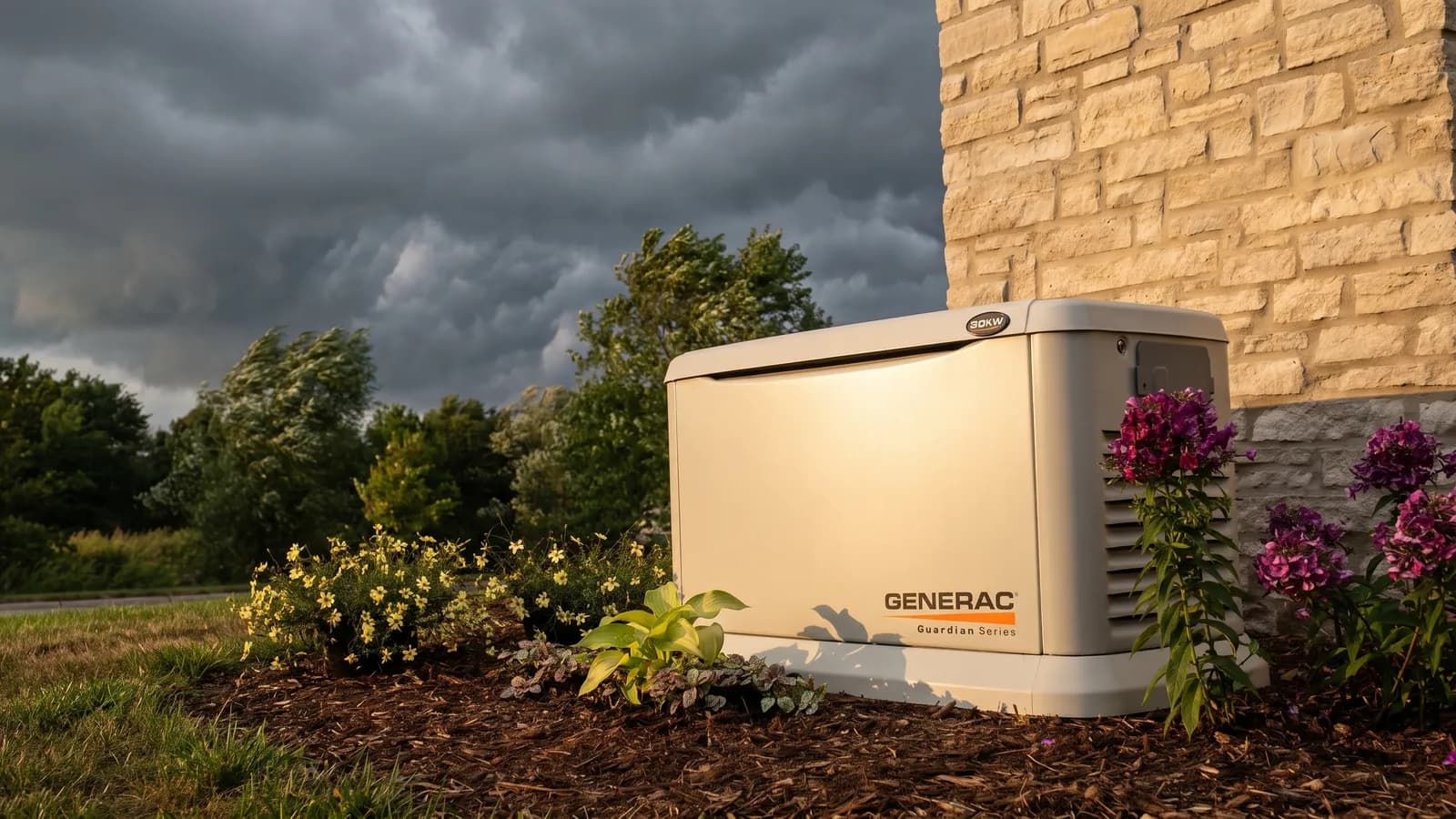
We're authorized for both, which frees us from having a horse in the race. Generac has the widest dealer network and cheaper parts; Kohler runs a bit quieter with a build-quality edge on premium installs. We recommend based on your house, your budget, and what's actually in stock the week you need it — availability in season is a real variable. Whichever you pick, mention the $200 generator coupon when you book. Full details on the standby generator page.
Why the install is a two-license job
A standby generator touches three trades: a concrete pad, a fuel line, and a transfer switch wired into your panel. In Massachusetts, the gas line is licensed-plumber work with a permit and pressure test; the transfer switch is licensed-electrician work with its own permit and inspection. Hiring those separately means two schedules, two permits, and — when something needs follow-up — two companies pointing at each other. We hold the gas and electrical licenses under one roof, coordinate the pad, and hand you one number to call. That's the actual reason to care who installs it, more than the badge on the cabinet.
The honest worth-it verdict
A standby generator is a four-to-five-figure project, so no hand-waving: if you're on town water, work elsewhere, have no medical equipment, and lose power for an hour a year, you don't need one — a portable and a transfer switch covers you. But with a well, a sump-pump-dependent basement, medical devices, or a home office, one avoided disaster — a flooded basement, a lost week of work, a freezer and fridge emptied twice — pays a real fraction of the install. Add that it runs a weekly self-test, starts in seconds while you're asleep, and adds resale value in a region that remembers its outages, and the math usually closes for the people it's built for. We install and service them across our whole service area — and we service all major brands, including generators we didn't install. (508) 944-7623.